Sliding Gate glossary of terms & specifications
15 technical terms, material grades and Irish standards explained in plain English so you know exactly what is on a written quote.
Sorted A to Z for quick reference when comparing specifications.
Free, no obligation. One vetted gate installer covering your county replies, not five.
Key sliding gate terms explained
24V DC Brushless Rack Motor
A low-voltage electric sliding gate motor with built-in obstacle amperometric sensing, soft-start/soft-stop speed control and battery backup for power cuts.
Back-Run Clearance
The unobstructed length required behind the entrance pier along the inside of your front wall so the sliding gate leaf can retract fully clear of the opening.
Cantilever Counterbalance Tail
An extra 35%–40% structural overhang built onto a trackless cantilever gate that stays engaged between two heavy-duty roller carriages bolted to a concrete pad behind the pier.
Composite Tongue-and-Groove Infill
Wood-plastic composite boards set inside a galvanised steel box-section perimeter frame, giving the warmth of cedar or oak without ever needing sanding or staining.
Dual Infrared Safety Photocells
Beams mounted across the entrance piers (and along the internal run-back zone) that immediately stop and reverse the sliding gate if a car, child or pet crosses the doorway.
EN 12453 Force & Safety Standard
The European machinery safety standard requiring powered driveway gates to prevent trapping, crushing or shearing hazards through obstacle detection, safety edges and photocells.
Galvanised V-Groove / Round-Bar Ground Rail
A 16mm–20mm solid steel floor rail bolted into a level reinforced concrete threshold beam across the entrance on which a tracked sliding gate's steel wheels roll.
GSM & Wi-Fi Intercom
A pillar-mounted weatherproof call point that rings your mobile phone wherever you are and lets you buzz couriers or visitors in via app or keypad code.
Hot-Dip Galvanising (EN ISO 1461)
Submerging the fully welded steel gate frame in a bath of molten zinc at 450°C so both the outside and hollow box-section interior are permanently protected against Irish coastal and rural rust.
Induction Ground Loop Detector
An electromagnetic wire loop buried beneath the inside driveway surface that senses an approaching car and opens the sliding gate automatically as you drive out.
Manual Release Key (Hex/Triangle Override)
A mechanical clutch lock on the rack motor housing that lets you disengage the gearbox in seconds and roll the sliding gate open by hand if the mains power is off.
Nylon-Coated Steel Toothed Rack
A modular toothed bar bolted along the bottom rail of the sliding gate leaf that meshes quietly with the motor's drive pinion gear to push and pull the gate.
Polyester Powder Coating (RAL Finish)
An electrostatic baked paint finish applied over hot-dip galvanised steel (after duplex sweep-blasting) in colours such as RAL 7016 Anthracite Grey or RAL 9005 Jet Black.
Portal Guide Post & Top Rollers
The vertical steel post inside the hinge pier fitted with twin nylon guide rollers that hold the sliding gate leaf plumb and resist wind load.
Rubber Resistive Safety Edge
A pressure-sensitive rubber buffer strip fitted to the leading edge of the sliding gate and guide post that halts movement instantly on contact.
Real examples and installation detail
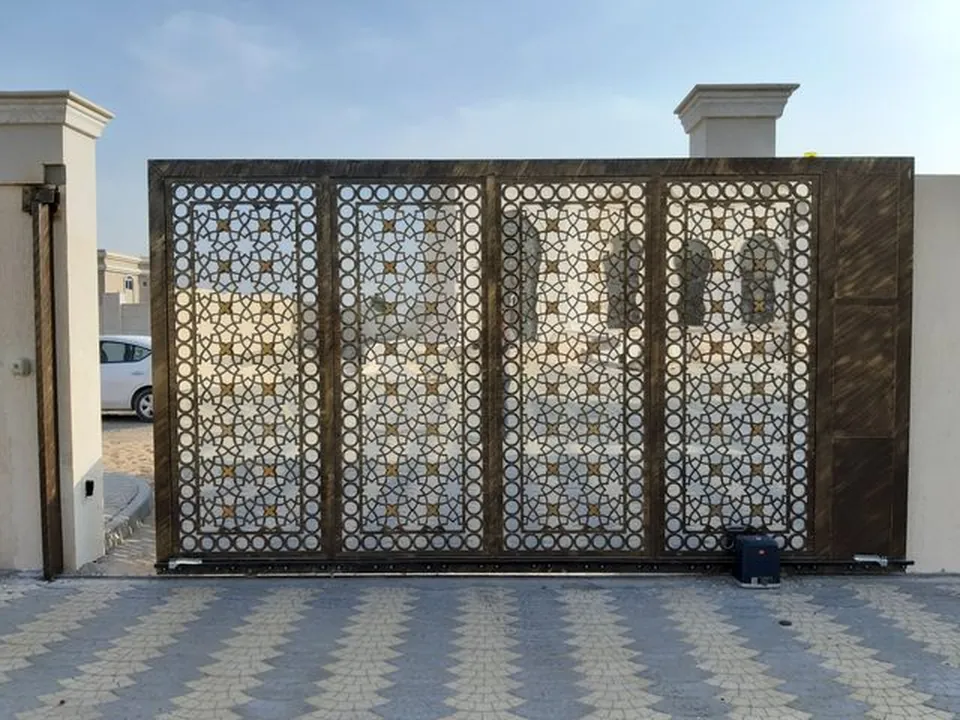

Get a sliding gate price for your entrance
Pick the gate type, track setup and your county. Your enquiry goes to one vetted sliding gate installer covering your county so they can measure your opening and side run-back.
Questions homeowners ask
How much does an electric sliding gate cost in Ireland?
An electric tracked steel sliding gate in Ireland typically costs €3,000 to €5,000 supplied and fitted (including the gate leaf, ground track, rack motor, safety edges, photocells and remotes). An electric powder-coated aluminium sliding gate costs €4,200 to €7,500+, and a trackless cantilever sliding gate costs €3,800 to €6,800 in steel or €4,800 to €8,500 in aluminium. If a new concrete ground-track beam is needed, allow €500 to €2,000.
How much space do I need to the side of my entrance for a sliding gate?
For a standard tracked sliding gate on a V-groove ground rail, you need straight, unobstructed run-back space behind one pier equal to the clear opening width plus 450mm to 600mm for the tail and motor mount (for example, a 3.6m entrance needs 4.1m to 4.2m of side run-back). For a trackless cantilever gate, allow 1.35× the opening width (about 4.9m for a 3.6m entrance).
When is a sliding gate better than swing gates?
A sliding gate is the right choice whenever your driveway rises uphill behind the piers (where inward-opening swing gates would ground out on the tarmac), where the driveway is short and cars park right behind the gate, or on exposed rural and coastal sites where strong winds can catch wide solid swing leaves and strain the motor arms.
Every guide, calculator and county page
Jump straight to any specification guide, our interactive calculator, the technical glossary or your county page.
Price & Specification Guides
Calculator, FAQ & Glossary
Want an exact price for a sliding gate on your driveway?
One vetted gate installer covering your county checks your opening width, side run-back and ground levels, and gives you a fixed written quote.